How GTA San Andreas was developed
Rockstar North’s three cities, location research, and technical work on the world, scripting and player character.
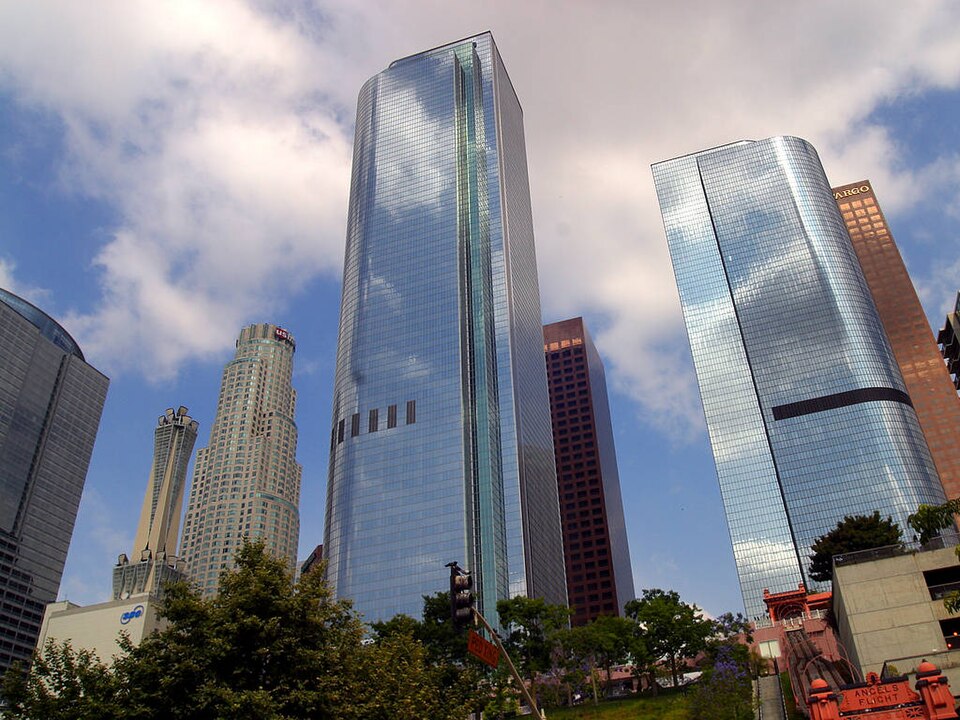
High-rise buildings in downtown Los Angeles. Real-world context for Los Santos; the shooting date is not supplied.
Image version & licence
Official Wikimedia preview, copied without further image editing. The layout may display a crop. The stated photo licence is retained. Open image file
Rockstar North and the platform sequence
San Andreas was created by Rockstar North and appeared on PlayStation 2 in 2004. The Xbox and PC announcement continues to identify that studio and schedules those releases for 2005. The original development and subsequent platform adaptations therefore represent different production stages. Comparisons with PC concern, among other things, its greater memory capacity and higher possible resolution, as Rockstar explains in the later technical interview. Those capabilities are relevant to the adaptation rather than the initial hardware target.
Three cities with distinct identities
Art director Aaron Garbut explained in 2004 that the areas should feel different while forming a coherent world. Los Santos, San Fierro and Las Venturas were more than three additional collections of roads. Garbut describes photographic research, an extensive team road trip and assistance from researchers in New York. Districts, architecture and landscapes would provide recognisable identities. He explicitly rejected size for its own sake and the repetition of identical buildings as worthwhile design objectives, explaining the importance of differentiation within the expanded setting.

PlayStation 2 was the game’s original platform. The photograph shows an SCPH-30001 model.
Image version & licence
Official Wikimedia preview, copied without further image editing. The layout may display a crop. The stated photo licence is retained. Open image file
Streaming, animation and a changing CJ
In GameSpot’s technical interview, Rockstar discusses changes supporting the larger exterior world, streaming and mission animation. A new animation-scripting interface enabled more customised sequences. CJ’s model had to support different body states, while his clothing was assembled from individual components. Character variation itself consequently became an engineering task. The work therefore concerned more than adding land: it also connected missions and animation to a protagonist whose appearance the player could change. This provides a concrete example of systems expanding together rather than independently.
Interpretation: countryside and mission pacing
In his interview, Dan Houser cites driving in Smuggler’s Run as a reference point for open landscapes. San Andreas would combine those spaces with GTA activities and other vehicles; he also describes alternating freer and more directed story phases. Our editorial interpretation is that the countryside contributes to pacing and variety. The expansion can therefore be understood as a new relationship between world design and mission rhythm, rather than merely a longer journey between familiar urban situations.
Recommendations and interpretation are editorial. Information may change after the date shown above.